Saturday, May 26, 2012

Lawson and Lima Park Ranches

Day 4:

Lawson's Angus cattle
We began the day at Lawson's Angus ranch this morning. It was yet another cold day full of drizzle but Mr. Lawson was kind enough to show us his herd and give us a valuable briefing of how his farm operates. Some background for this ranch was that he and his brother took over the ranch from their father right out of college roughly twenty years ago. They were lucky enough to see agriculture across the globe and made decisions with that information regarding how they wanted their ranch ran. Using many of the same concepts and genetics as the Gardiner Angus ranch that is local back home. I saw a huge change in the treatment of cattle here than in the states. The Lawson ranch is a very intensive ranch that utilizes the local rye grass and clover to grow out their cattle with a huge reliance on survival of the fittest. They put a greater stress on their cattle as calves by forcing them to compete with each other to get a true idea about how each of their genetics will play out instead of catering to the cattle that aren't performing up to par. They do have some advantages over most farms in the U.S. through a 90% A.I. conception rate with use of a higher quality GnRH and an animal-friendly endophyte grass that retains the insect resistance without the increase of grass tetany.
Lima Park's Hereford cattle
Next we visited the Lima Park Hereford ranch where I saw a very different perspective. Mr. McMillan has a mixed farm running around 3000 sheep and 500 head of cattle. He primarily sells his cattle and sheep to the European Union with wool going to China. His practice is strange compared to those common in the U.S. due to the fact that his average cow weight is around a ton and he does not retain heifers out of heifers. I did find it fascinating that he had a product called "Clik" that was used to eliminate fly strike in his ewes for the summer months. Tomorrow we visit both a sheep and emu operation so stay tuned for some fun facts about those species.

Friday, May 25, 2012

JBS and Webb Ranch

Day 3:

After our visit to the JBS Abattoir
Our first stop this morning was at the JBS Abattoir in the Brooklyn area of Melbourne. this was an amazing operation with great efficiency. Just to throw some numbers out there to gain a better understanding; they process around 5000 sheep and just under a thousand head of cattle daily. It takes roughly 30 minutes to process a beef carcass before chilling for 24 hours and an additional 30 minutes to process and package to the point where it is ready to ship to the retailer (Coles being the major supermarket is the most focused on). They employ roughly 1200 employees to operate this facility; each being a 14% increase in cost of production. Although they do not have the same products as sold in the United States, they are opening new segments such as per-seasoned and pre-cooked beef and lamb to their customers here in Australia. The major difference I saw between the two countries were their primary focuses. While in the United States we focus on quality and yield grade and the natural and hormone free beef is purely a niche market and lamb only consuming a small portion of the market, Australian beef and lamb is HGP (hormone growth promotant) free due to the demand from their customers and has a great emphasis on natural grass fed beef and lamb. The last difference I observed was the high demand from Coles for bone and offal used in many popular dishes here in Australia.
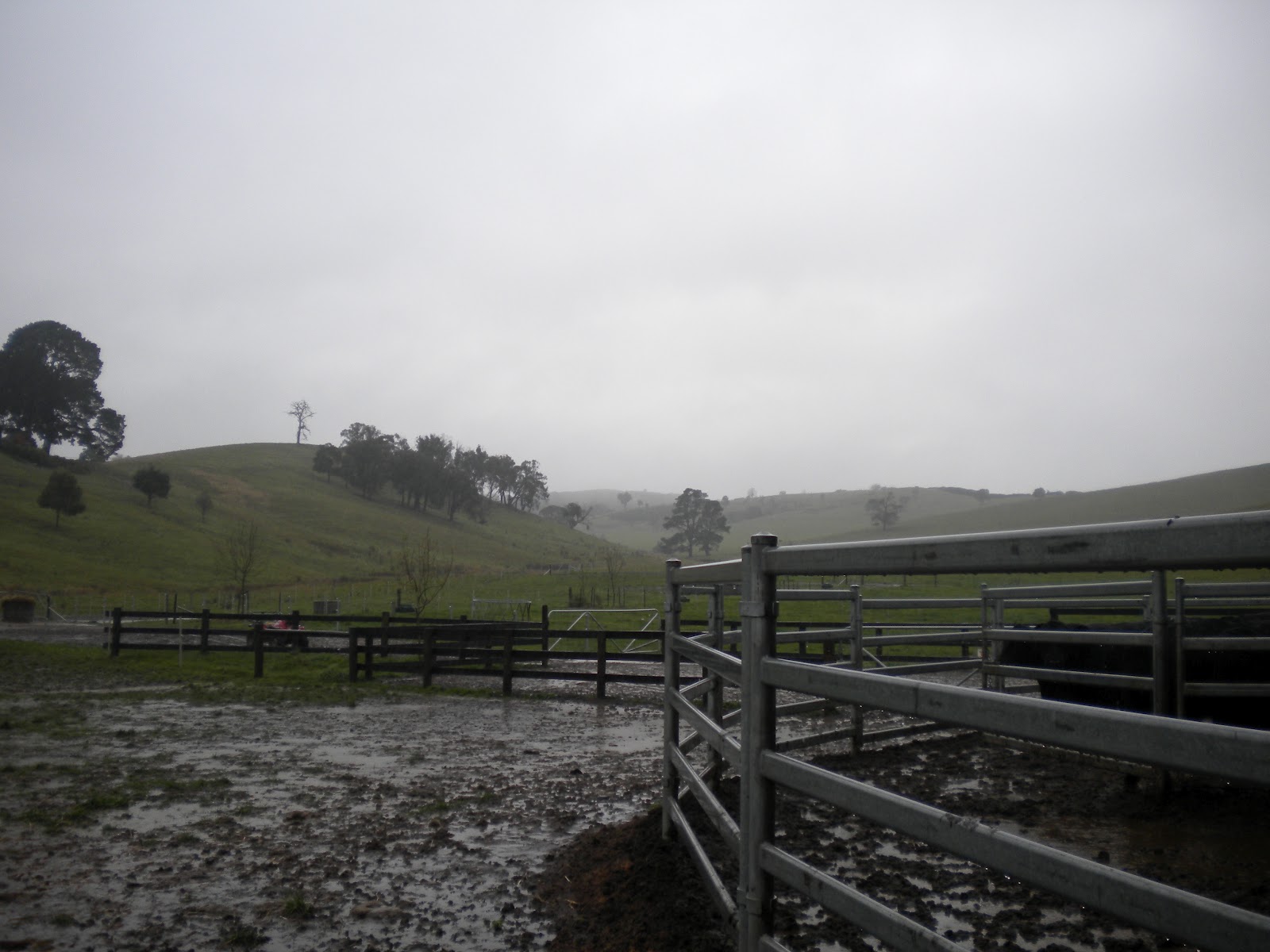
The Webb ranch on a rainy day

 Later we ventured to the Webb Black Simmental ranch. Unfortunately it was raining so we did not get to view all of the roughly 1600 acres but we did get to see the sale ring and catch pens and I must say they were VERY nice. We had a good discussion with the Webb brothers regarding the introduction of the Simmental breed to Australia and the operation itself. All in all I was impressed with the organization and boldness to be one of the first large Simmental breeders in Australia and wish them the best of luck.

Victorian D.P.I. And the Carlton United Brewery

Day 2:


Victorian Department of Primary Industries
A few group members stuck inside the brewery
We started the day off with a visit to the Victorian Department of Primary Industries and got several extensive lectures regarding the animal identification system used here to track where to and from the meat is transferred throughout Australia. There are a few ways to do so but they all follow the same concept. Each and every animal is given an identification number that includes the origin of the animal and their individual number. In one system they use electronic ear tags and a wand or stationary reader to record the animal at each location. They have furthermore created a system to link all of the systems used so each location that the animal is tracked at is given all information available on the animal. After leaving the department our bus driver Richie took us on a lovely tour of the city. We were fortunate enough to see marvelous architecture and the rugby and soccer stadiums where some of the national tournaments are played. We continued on and stopped at the Shrine of Remembrance where they honor those fallen in the Korean War. We also stopped and toured such monuments as the Botanical Gardens, The home of Captain Cook, and the St. Patrick's Cathedral. After taking countless pictures we left to visit the Carlton United Brewery where such beers as the Carlton Draught, Foster's, and Crown Lager are made. I learned from our tour guide that they distribute around 2 million liters of beer annually and that they can make several thousand cans and bottles of beer a minute. A fact I found fascinating was that with the massive amounts of alcohol pushed out daily, it takes Australians only 3 to 5 days to consume 100% of the beer that requires 3 to 4 weeks to brew. Lastly I would like to give a special thank you to Geneveve who rescued us when we were locked in the brewery and provided us with complimentary beverages before concluding our visit.

Wednesday, May 23, 2012

Healesville Wildlife Sanctuary

Day 1:

A koala bear in the Healesville Wildlife Sanctuary
A statue of "Banjo" the eagle
After a 16 hour flight in a broken chair over the Pacific, I finally arrived in Australia. Landing in the growing city of Melbourne, we went directly from the airport to grab a snack at the local McDondald's. Although the restaurant was the same as in the states, we did have our first moment as true tourists when we spotted a parrot perched in a tree in the parking lot. From there we left to visit the Healesville Wildlife Sanctuary. I didn't manage to capture a kangaroo or koala bear (sorry all those who were relying on me) but I did get a good look into the local wildlife and history of the area. Sitting just inside the entrance was a remarkable statue of an eagle. The story behind the statue was created by the Aboriginals to tell of the creation of Australia. Following the fall of a great star toward Earth, the eagle "Banjo" was born. Banjo first created land, then realizing the need created water. He then formed a rainbow that shattered and led to the existence of parrots (explaining their various and vibrant colors). I was lucky enough to catch the "Birds of Prey" show put on by a couple of the zoo employees. They displayed the fascinating abilities of the birds to mimic, hunt, and even follow several instructions without a second command. The zoo had a display of the top 10 deadliest snakes in Australia (behind a secure piece of plexiglas). They also had three Dingos that I learned an descendants of the Asian wolf. But the most important tidbit I brought away from my trip was that we can all work to save these endangered species by following the instructions of Captain Crapman and "Wipe for Wildlife: Buy Recycled Toilet Paper", but keep in mind that the first step is the hardest: change.

Tuesday, May 1, 2012

Australia in a Nutshell


Australia is a country that provides many unique and diverse gems that can only be seen here. So for several reasons, I am extremely excited for my visit to the continent across the Pacific. I am fortunate to be taken on an exploration through Kansas State University’s study abroad program and will be visiting the cities of Melbourne, Victorian, Wagga Wagga, and Sydney to name a few. I am most excited to visit Sydney and the Great Barrier Reef, but will be exposed to the variation in agriculture by visiting several other locations scattered throughout Australia. In order to prepare myself for the trip, my classmates and I have done research to prepare ourselves for the quest.
 The geography of Australia is distinctive by being the only country that is also an entire continent. Furthermore, it is the flattest and driest continent, preceded only by Antarctica. A few things I found interesting about the Australian government is that it is illegal to walk on the right-hand side of the pavement and also illegal to give name to an animal intended for slaughter. The currency of Australia also had a peculiar beginning. The holey dollar and the dump were developed to ensure the coins did not return to Spain by separating the coin into an inner and outer part. The culture of Australia was mirrored off its English settlers, making rugby a favorite in Australia, and Christianity the primary religion, which replaced the “Dreamtime” spiritual concept developed by the Aboriginals.

A well-known feature of Australia, the Great Barrier Reef, is also known as the Blue Outback and spans a length greater that the Wall of China. On land is the Rainforest of Northern Queensland. With only two definite seasons, the “green” and the “dry” seasons, it is one-of-a-kind. Additionally, it contains the largest mountain in Australia, Mt. Bartle which stands over a mile tall.


Mount Bartle of the Rainforest of Northern Queensland


Almost all of the farms in Australia are family-owned, each feeding approximately 600 people. 61% of its vast land mass is occupied by farm ground that produces crops similar to the United States with a greater focus recently placed on their nut production. Australia is currently the second largest beef exporter worldwide, with beef contributing 18% to farm values and sheep accounting for 25%. Following many mergers with existing feedlots, Cargill and JBS are well-established in Australia. The primary difference between the Australian locations and others worldwide is the 93 page document of environmental restrictions to abide by.

http://www.saleyards.info/index.cfm

Although sale yards and livestock sales are similar to those in the U.S., the Wagga Wagga Livestock Market utilizes a system where the auctioneers and buyers are located in an arena above the cattle instead of at eye level. Several breeds such as Angus, Herefords, Shorthorns, and Simmentals have made their name in Australia, along with the popular sheep breeds, the Merino and the Suffolk. The Emu, a bird that is scarcely popular worldwide, is also a significant part of Australian agriculture.

Tuesday, March 27, 2012

The Blue Mountains and Beyond


 Due to the numerous gold settlements outlining Sydney, the Blue Mountains were first explored in 1812. Utilizing its riches to raise sheep and cattle, rural living was became comfortable in the late 19th century to the early 20th century with the advancements in communication. It is now home to the densest rural population in the country. It has easily become the favorite vacation spot for travelers. Important to the Blue Mountains is the Blue Mountains National Park. Estimated to be approximately 250 million years old, the name derived from the blue haze produced from the Eucalyptus tree oil. Visitors may experience these natural wonders by visiting the Cathedral of Ferns, the Jenolan Caves, Wentworth Falls, the Three Sisters rock formation, Mount Wilson, and the Mount Tomah Botanic Garden; alongside structures such as the Leura Mansion, the Norman Lindsay Gallery and Museum, and towns of Katoomba and Blackheath.
The Three Sisters of the Blue Mountains National Park
 The cities of the Blue Mountains are also riddled with history. Windsor and Richmond are home to the colonial Hawkesbury Museum and the Mountainview farmstead. If one moves northeast toward the central coastal city of Gosford, the Ku-ring-gai Chase National Park, the Australian Rainforest Sanctuary, the Brisbane Waters National Park (containing the Bulgandry Aboriginal site), and the popular Australian Reptile Park are sought after attributions. Up the coast is the town of Newcastle, Australia’s second oldest city. Built in haste due to the coal and steel mining boom, an assortment of architecture styles can be seen including Late Free Classical, High Victorian, and Victorian Gothic, in addition to visiting the Newcastle Region Art Gallery, the Nobby Lighthouse in Queens Wharf, and Fort Stratchley.

The Nobbys Lighthouse and signal station
With wine being a huge part of Australia’s economy, it is sensible that there are numerous wineries travelers should explore. To name a few would be the Hunter Valley Winery, located off the Hunter Valley River and home to the Hunter Valley Wine Society, the Rothbury Estate, which also provides a well-known breakfast and hot-air balloon ride, Lake’s Folly, and the Peterson’s Winery. Most would also recommend traveling to the Northern New South Wales Coastlines which is home to many memorizing beaches and unique harbors.
Going west of the divide, the cities of Dubbo, Bourke, and Broken Hill contain contributions to the scattered history of Australia. Most popular is the city of Wagga Wagga. Translated as “a place of many crows” and known across the country as the “Garden City of the South”, Wagga Wagga is covered in wineries and gardens designed for a relaxing and revitalizing vacation. Also found in the city is the Wagga Wagga Historical Museum and Widadjuri trail.